

Thyroid Scan vs Blood Test: What’s the Difference?
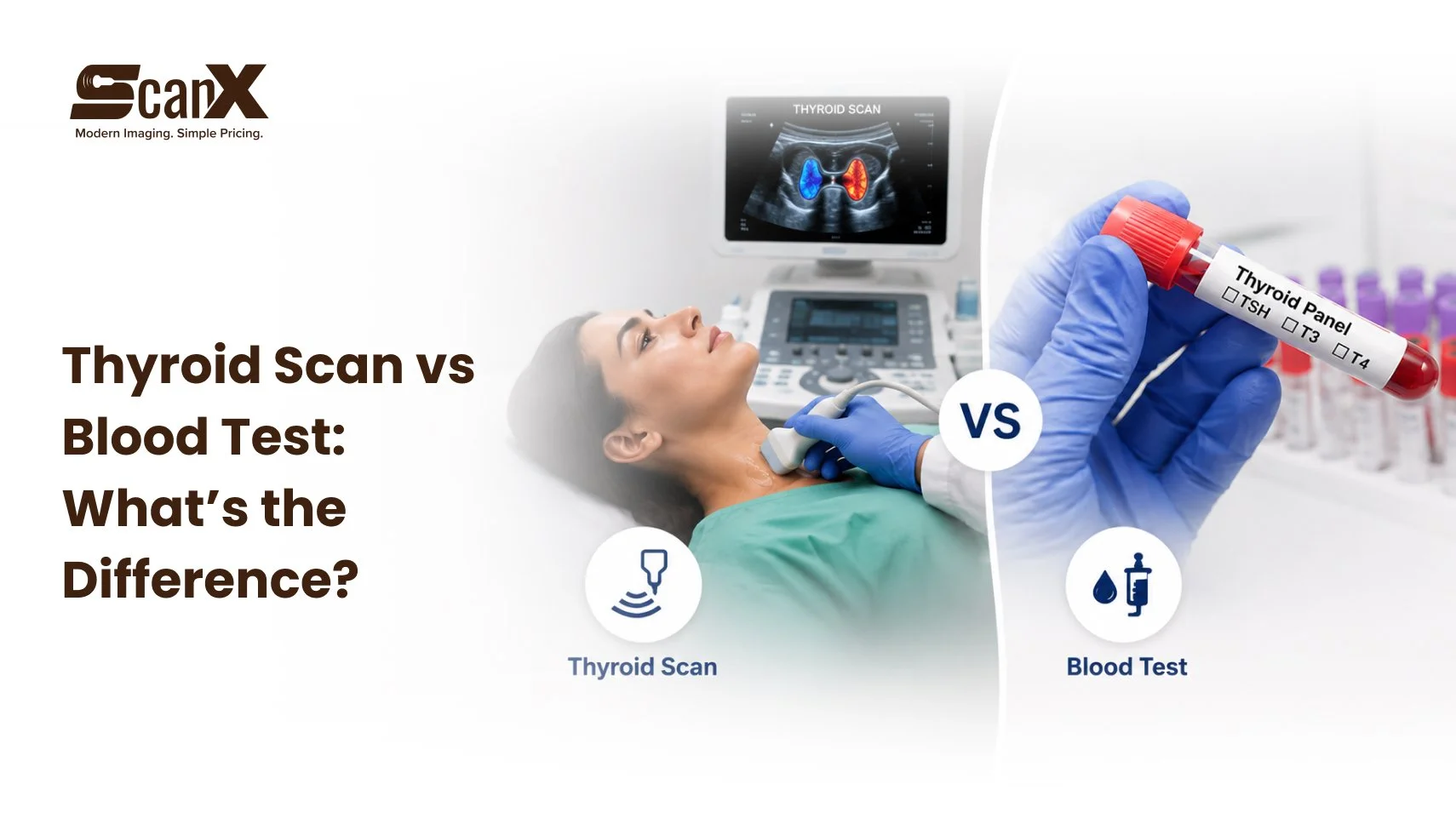
Thyroid dysfunction is quite normal; however, it often goes unnoticed. If you are experiencing symptoms such as persistent fatigue, unexpected weight gain or loss, hair loss, emotional imbalance, or a lump in the neck, your doctor may instruct a thyroid checkup. This often leads to a usual question: Do you need a thyroid scan or a blood test?
The answer is simple - both tests serve several purposes. A thyroid blood work explained check how well your thyroid is functioning, while a thyroid ultrasound scan shows the size, shape, and structure of the thyroid gland. One test checks function, and the other checks structure, so both are important for an adequate diagnosis.
At ScanX, a trusted ultrasound diagnostic centre, we offer high-quality thyroid ultrasound scans that support blood test results and help doctors make accurate decisions. The thyroid blood test vs thyroid scan is a blood test that checks hormone levels (TSH, T3, T4), while a thyroid scan shows the gland’s size and structure.
In this article, we will clarify the differences between thyroid scans and blood tests, when you need each, and why combining them yields the best results.
Check out our latest article, “How Much Does a Thyroid Scan Cost Near Me?” for a quick, easy overview of the scan.
Thyroid Blood Test: What It Shows and Its Limitations
A thyroid blood test reviews the hormone levels and antibodies in your blood to understand how your thyroid gland is working. It is one of the most significant tests for diagnosing thyroid problems. Thyroid diagnostic tests contain blood tests to measure hormone levels and scans to assess the gland’s structure and condition.
A thyroid ultrasound is a safe, quick, and completely painless test with no radiation exposure, making it a reliable way to check and track thyroid health. At ScanX, get exact ultrasound reports examined by experienced radiologists for clear diagnosis and better treatment decisions.
The most prevalent thyroid blood tests include:
TSH (Thyroid-Stimulating Hormone):
This is the primary thyroid function test. High TSH blood test could indicate an underactive thyroid (hypothyroidism), while low TSH may suggest an overactive thyroid (hyperthyroidism).
Free T3 and Free T4:
These are the true thyroid hormones. Testing them alongside the TSH blood test enables a clear picture of your thyroid health.
Anti-TPO and Anti-Thyroglobulin Antibodies:
These tests help discover autoimmune thyroid conditions like Hashimoto’s thyroiditis and Graves’ disease.
Thyroglobulin:
This test is commonly used to supervise patients after thyroid cancer treatment.
Calcitonin:
This is examined when there is a doubt of medullary thyroid cancer.
Thyroid blood tests primarily answer one key question: Is your thyroid producing the right amount of hormones? They are essential for diagnosing thyroid disorders and for monitoring patients who are on thyroid medication.
Thyroid Blood Test vs Scan: Limitations of Blood Testing
Thyroid blood tests vs. thyroid scans help doctors accurately diagnose thyroid issues consistently by combining functional and structural insights. Although thyroid blood tests are essential, they have some limitations:
A thyroid blood test cannot detect structural issues in the thyroid gland, for instance, nodules, cysts, or goitre.
It cannot tell whether a thyroid nodule is harmless or cancerous.
A normal TSH level does not prevent thyroid nodules or early thyroid cancer, as various thyroid cancers do not influence hormone levels.
A thyroid blood test can not provide statistics on the thyroid gland’s size, shape, or blood flow (vascularity).
It cannot detect key features, such as calcifications or unusual borders, that might suggest a higher risk of cancer.
The thyroid imaging test helps visualize the thyroid gland to check its size, shape, and any abnormalities.
In a nutshell, thyroid blood tests only check how the thyroid functions, not how it looks.
Also, read our article “Understanding the Cost Differences Between Insurance and Self-Pay at ScanX” to understand pricing and insurance options.
Thyroid Ultrasound vs Blood Test: What More Does a Scan Show?
Understanding the difference between a thyroid scan and a blood test helps in accurate diagnosis by combining functional and structural insights. A thyroid imaging test is often used alongside blood tests to improve thyroid diagnosis accuracy.
What Is a Thyroid Ultrasound Scan?
A thyroid ultrasound is a safe, painless diagnostic procedure that uses high-frequency sound waves to generate clear, real-time images of the thyroid gland. It is one of the best practices for evaluating thyroid structure without radiation exposure. A thyroid gland scan is an imaging test that helps evaluate the size, shape, and structure of the thyroid.
This scan can identify even really small irregularities (as small as 2 to 3 mm), making it very precise for recent diagnosis.
You can also explore our latest article, “Thyroid Ultrasound Test: Why It’s Done, Cost & Normal Results Guide” for quick and helpful insights on Thyroid Ultrasound.
Here’s what a thyroid ultrasound can help identify:
1. Thyroid Nodules: Measuring Size, Number, and Risk Factors
Thyroid nodules are quite common and can be diagnosed on thyroid ultrasound in roughly 50% of people. In the majority of cases, these nodules are benign (non-cancerous). A thyroid ultrasound helps doctors precisely evaluate each nodule, determine its specific location, and measure significant features that indicate the risk of thyroid cancer.
During scanning, specialists evaluate whether the nodule is solid or fluid-filled, as solid nodules may be at higher risk. They also look for unusual or unclear borders, tiny calcium deposits (micro-calcifications), and a taller-than-wide shape, which can be warning signs. Other aspects, such as increased or irregular blood flow on Doppler imaging and a darker (hypoechoic) appearance compared to surrounding tissue, can also raise issues.
On the basis of these ultrasound features, radiologists classify thyroid nodules into risk categories using standardized systems. This helps doctors decide the next steps, whether it is a fine needle aspiration biopsy (FNAC), regular monitoring, or simply reassurance if the nodule appears harmless.
2. Thyroid Goitre: Symptoms, Diagnosis, and Care
A goitre develops if the thyroid gland enlarges, often due to underlying thyroid conditions. It affects the entire gland (diffuse goitre) or results from one or more thyroid nodules (nodular goitre). A thyroid ultrasound plays a major role in diagnosing goiter by correctly measuring the thyroid gland’s size, shape, and toyal volume. Eventually, this helps doctors monitor changes and decide on the appropriate care, such as medication, radioiodine therapy, or surgery. Early-stage diagnosis and adequate assessment of thyroid enlargement can help manage the signs completely and avoid complications. A thyroid gland scan can detect nodules, swelling, or other abnormalities for accurate diagnosis.
3. Thyroiditis: Signs, Causes, and Treatment Options
Hashimoto’s thyroiditis and De Quervain’s thyroiditis are common types of thyroid inflammation that show clear changes on a thyroid ultrasound. Both Hashimoto’s thyroiditis and De Quervain’s thyroiditis are painful, normally temporary thyroid inflammation, and generate characteristic alterations in the emergence of the thyroid gland on ultrasound. In Hashimoto’s thyroiditis, the gland usually appears heterogeneous (uneven texture), eventually becomes smaller than normal, and may exhibit a characteristic coarsened echotexture. These features, merged with positive antibody blood tests, confirm the diagnosis. Early screening for thyroiditis using ultrasound and blood tests helps ensure proper management and treatment of thyroid disorders.
4. Thyroid Cysts
Pure thyroid cysts are smooth, fluid-filled sacs in the thyroid and are usually harmless (benign). On ultrasound, doctors can immediately identify a simple thyroid cyst from a complex cystic nodule, which has both fluid and solid components and might require further assessment.
This clear difference helps with adequate diagnosis, reduces unnecessary worry, and prevents unnecessary tests or surgical procedures.
5. Lymph Node Scanning for Infection and Cancer Detection
During a thyroid ultrasound, the radiologist also inspects the nearby neck lymph nodes. Abnormal or suspicious lymph nodes – those that are enlarged, rounded, or show internal calcifications – may indicate thyroid cancer spread and will be asked for further investigation.
This significant assessment of lymph nodes cannot be performed with a blood test, underscoring the importance of ultrasound for accurate thyroid diagnosis.
Thyroid Ultrasound vs Blood Test: Which One Do You Need?
The best way to decide whether you need a thyroid ultrasound or just a blood test for thyroid issues is to choose the test that best addresses the specific clinical question. Using thyroid diagnostic tests together helps doctors more accurately diagnose and manage thyroid disorders.
When Doctors Recommend a Thyroid Blood Test First
If there are symptoms of hypothyroidism, such as fatigue, weight gain, cold intolerance, dry skin, constipation, hair loss, depression, or a slow heart rate, then you should get a thyroid blood test first.
A blood test is also advised if you have symptoms of hyperthyroidism, which include weight loss, rapid heartbeat, anxiety, tremors, heat intolerance, or diarrhoea. In some cases, a thyroid test for hyperthyroidism may also include imaging scans to assess thyroid activity and function.
It is also helpful if you have already tested positive for a thyroid condition and are on treatment, or if your doctor is scanning for autoimmune thyroid disease due to family history or other autoimmune diseases.
Pregnant women or those planning pregnancy should also have a thyroid blood test, as a normal thyroid function test is extremely important in early pregnancy.
When Doctors Recommend a Thyroid Ultrasound
If your doctor feels a lump or nodule in your neck during a physical examination, you should have a thyroid ultrasound. A thyroid scan explained the thyroid gland’s size, shape, and structure.
A thyroid scan is also advised if you observe or experience swelling at the base of your throat, or if a thyroid nodule is found unexpectedly. Another imaging test, such as a neck CT scan or carotid Doppler, may also be performed.
You may also require a thyroid ultrasound if you have a family history of thyroid cancer, especially medullary thyroid cancer or MEN syndrome, or if you have had previous radiation exposure to the head, neck, or chest.
Doctors may recommend a thyroid scan when blood test results are abnormal and additional structural evaluation is needed, or if you already have a known thyroid condition that requires monitoring of thyroid size or nodules over time.
It is also advised that you seek medical attention if you experience symptoms such as hoarseness, difficulty swallowing, or a feeling of pressure in the throat without a clear cause.
When You Need Both Thyroid Blood Test and Ultrasound
When you have both functional symptoms, such as fatigue or unexplained weight changes, and a noticeable neck lump. You should get both a thyroid blood test and a thyroid ultrasound.
Both tests are also required if a new thyroid nodule has been found, and your doctor wants to understand its structure and how your thyroid gland is functioning.
In certain cases, doctors may advise both tests before a biopsy to get complete details for an adequate diagnosis.
A combined thyroid evaluation is also useful for a full thyroid health check after a diagnosis of thyroid disease. A thyroid scan, explained, helps detect nodules, swelling, or other abnormalities in the thyroid.
When Is a Thyroid Ultrasound Needed for FNAC Biopsy?
If a thyroid nodule shows doubtful ultrasound features, the next step is normally Fine Needle Aspiration Cytology (FNAC). This is a slightly invasive biopsy where a thin needle is used to accumulate a small sample of cells from the thyroid nodule for lab testing.
At ScanX, we perform ultrasound-guided FNAC, using real-time ultrasound to correctly guide the needle to the nodule. This higher accuracy decreases the risk of sampling errors and increases the possibility of obtaining a clear diagnosis on the first attempt.
Ultrasound-guided FNAC is recommended in cases where the thyroid nodule is solid and hypoechoic with suspicious features, is larger than 1 cm, and has intermediate-risk characteristics, or shows growth on follow-up scans. It is also advised that if there is a personal or family history of thyroid cancer, or if suspicious lymph nodes are seen in the same scan, further evaluation is necessary.
The FNAC procedure is quick, usually completed in a few minutes, does not require anaesthesia, and patients can continue routine activities the same day. Cytology results are typically available within a few days, helping doctors decide on the right treatment plan.
Why ScanX Is a Trusted Choice for Thyroid Ultrasound in Dallas
When it comes to thyroid health, the quality of your ultrasound imaging plays a key role in accurate diagnosis. At ScanX, we concentrate on delivering precise and reliable thyroid ultrasound services using advanced technology and expert care. Our high-resolution ultrasound machines can detect thyroid nodules as small as 2mm, which helps in the early detection of thyroid abnormalities.
We also use Color Doppler ultrasound to evaluate blood flow in the thyroid gland and nodules, providing additional diagnostic details for better clinical assessment. For patients who need further evaluation, we offer ultrasound-guided FNAC, a minimally invasive, highly accurate biopsy procedure performed on-site by experienced professionals, without the need for an external referral.
To ensure faster treatment decisions, we provide same-day reporting so your doctor can quickly review the results and plan the next steps. Our pricing is affordable and transparent, with no extra charges, and we offer flexible packages for thyroid ultrasound (with or without Color Doppler) and FNAC.
Conveniently located in Dallas, serving Arlington patients, ScanX is easily accessible for patients from Rockwall, Rowlett, Irving, Flower Mound, Arlington, McKinney, Frisco, Garland, Plano, Allen and nearby areas.
Nuclear medicine imaging, similar to a thyroid uptake scan, falls under this category and involves swallowing or injecting a small amount of contrast material.
At ScanX, we focus on providing affordable, transparent, and patient-friendly ultrasound imaging services in Dallas and Fairview at competitive prices.
You can also take advantage of our Patient Referrals at ScanX to access quick, convenient, and cost-effective imaging services.
Conclusion
Both thyroid scans (ultrasound) and blood tests are necessary for the purpose of checking thyroid health. Blood tests measure hormone levels such as TSH, T3, and T4, whereas a thyroid ultrasound assesses the size, shape, and structure of the thyroid gland. Simultaneously, they give a complete and adequate diagnosis.
If you are looking for reliable thyroid ultrasound services, ScanX offers fast, accurate, and comprehensive scans. Our proficient team ensures you get clear results and proper guidance for your health.
Book your thyroid scan today and take the next step toward better thyroid care.