

Understanding IVF Monitoring Ultrasounds: A Patient's Guide
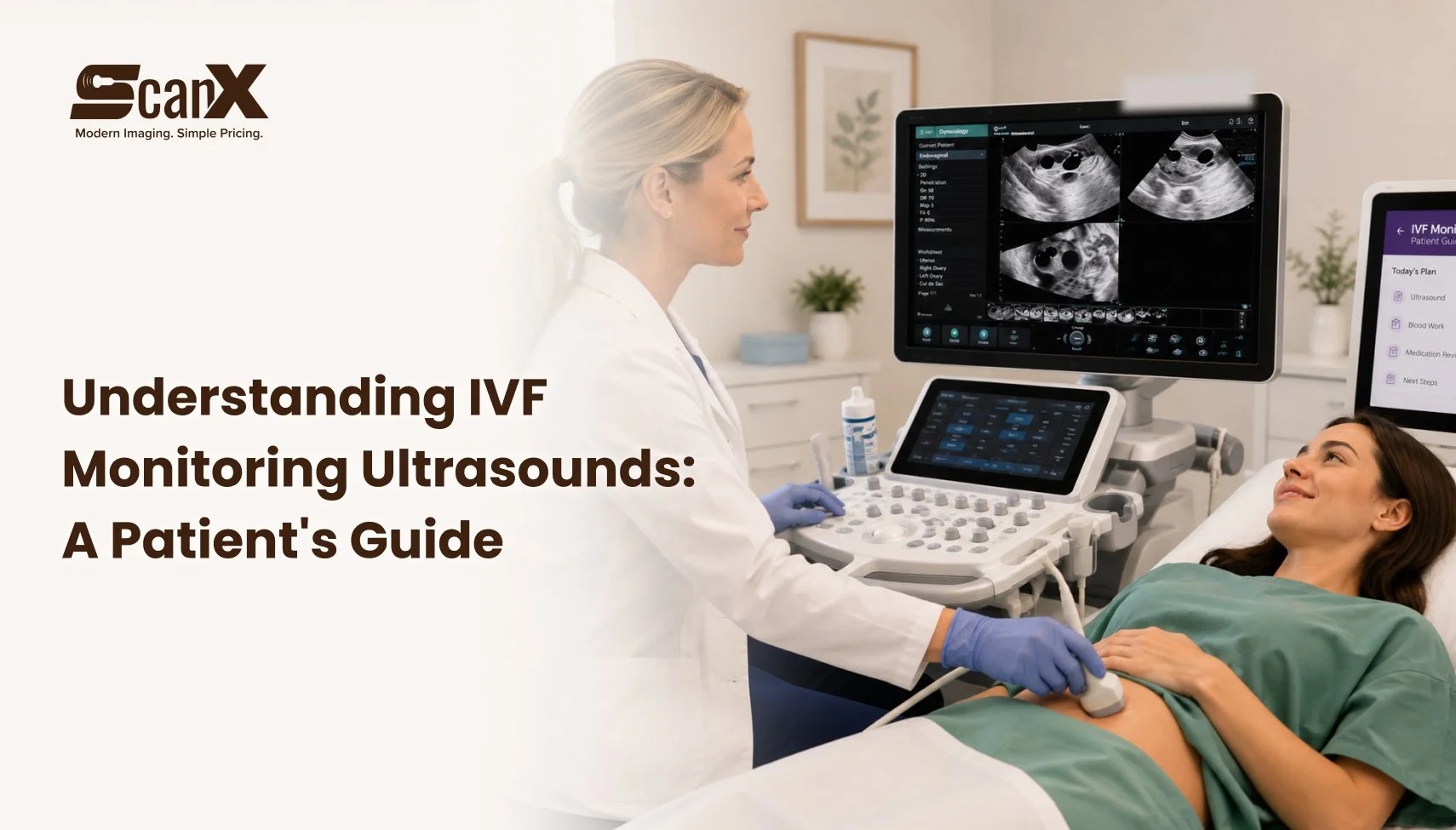
Ultrasound monitoring plays an essential role during the IVF journey, giving your medical team real-time monitoring and giving you, as parents, added reassurance every step of the way.
IVF procedures can feel overwhelming at times. But knowing what to anticipate from each ultrasound scan during your IVF cycle can bring clarity and ease your stress.
This guide walks you through the different IVF ultrasound scans, when they happen, and what to expect at each stage. With this knowledge, you and your partner can feel more prepared and involved, turning anxiety into confidence during your next visit to ScanX. This complete IVF ultrasound guide helps you understand every monitoring scan in your treatment journey.
Let’s start at the beginning: the baseline scan, done before your IVF treatment begins.
What is IVF?
IVF (In Vitro Fertilisation) is the most common and extensively used form of assisted reproductive technology (ART). During IVF, a woman’s healthy, mature eggs are combined with a man’s sperm in a lab dish, where fertilisation takes place outside the body. IVF egg retrieval ultrasound is used to guide the procedure in real time, helping doctors precisely locate and retrieve mature eggs from the ovaries.
Here’s a clear guide to understanding ultrasound during IVF and what each scan means for your treatment journey.
To better understand the process, read our detailed guide on “IVF Monitoring Ultrasounds: Everything You Need to Know” and what each scan means for your treatment journey.
What is IVF monitoring ultrasound?
IVF monitoring ultrasound connects with the succession of ultrasound scans performed throughout an IVF cycle to track and guide the treatment in real time. Instead of being a single scan, it’s actually a set of ultrasounds done at different phases, each serving a specific purpose.
IVF ultrasound monitoring is the continuous use of high-definition ultrasound, most frequently a transvaginal ultrasound, to track how your reproductive organs develop and respond throughout your IVF cycle. These scans give doctors real-time visuals of your ovaries, follicles (the fluid-filled sacs that contain eggs), and the uterine lining (endometrium).
Assisted reproductive technology (ART) includes advanced medical procedures like IVF that help individuals and couples achieve pregnancy by handling eggs, sperm, or embryos outside the body.
A Fertility clinic provides specialized medical care, advanced treatments, and personalized support to help individuals and couples achieve successful conception.
IVF monitoring scans work differently from a standard pregnancy ultrasound. Instead of checking on a growing baby, doctors are tracking:
The number of follicles developing
How much each follicle grows in size over time
The speed of follicle growth
The thickness of the endometrium (uterine lining), which changes in response to hormone treatment
This guide walks you through IVF follicle monitoring and what to expect at every stage of your treatment. Ovarian follicles are small fluid-filled cysts in the ovaries that contain and nurture developing eggs, playing a key role in ovulation and fertility. Egg maturation is the biological process in which an immature egg develops within the ovary to reach a stage where it can be successfully fertilized.
For a detailed breakdown of scan pricing, read our latest article: “Understanding the Cost Differences Between Insurance and Self-Pay at ScanX.
What is a transvaginal ultrasound (TVS)?
A transvaginal scan is the main scanning method used in IVF monitoring. It involves a small, smooth probe gently inserted into the vagina to get a close, clear view of the pelvic organs. Compared to abdominal ultrasound, TVS provides sharper, more accurate images, while still being a quick and comfortable procedure for most patients. Pelvic ultrasound is a non-invasive imaging test used to evaluate the uterus, ovaries, and surrounding structures, helping diagnose conditions and monitor fertility health.
At ScanX, each ultrasound is reviewed by a board-certified radiologist, ensuring exact results and high-quality care.
IVF Ultrasound Monitoring: A Stage-by-Stage Guide
Here’s a general breakdown of what it usually involves:
1. Baseline scan
Done before treatment starts, usually early in the menstrual cycle. It checks the ovaries and uterus to confirm they’re resting and ready for stimulation medication to begin.
2. Follicular monitoring scans
Once ovarian stimulation medication starts, several scans are done (often every 2-3 days) to track:
The number and size of expanding follicles (fluid-filled sacs containing eggs)
The thickness and usage of the uterine lining (endometrium)
These scans help the doctor adjust medication doses and decide the right time for egg retrieval.
3. Trigger shot timing scan
A final scan before the “trigger injection” (which matures the eggs) confirms the follicles have reached the ideal size for retrieval.
4. Post-retrieval and embryo transfer scans
After egg retrieval, an ultrasound may be performed to check the ovaries. Later, ultrasound is also used to guide the embryo transfer procedure, ensuring accurate placement of the embryo in the uterus.
5. Early pregnancy scan
About 2-3 weeks after embryo transfer, a scan confirms pregnancy and checks for a heartbeat, along with ruling out complications like ectopic pregnancy.
IVF Ultrasound Monitoring: Why It Matters
IVF isn’t a one-size-fits-all treatment; every patient responds differently, so treatment needs to be personalised. The hormone doses used to stimulate the ovaries must be tailored to your body’s response, and the only way to track that response accurately is through regular ultrasound scans combined with blood hormone tests.
Here’s why monitoring plays such an important role in IVF:
Tracks ovarian response
Confirms whether your ovaries are responding well to stimulation medication.
Guides dosage adjustments
Helps doctors fine-tune hormone doses for better egg development.
Detects OHSS risk early
Identifies patients at risk of Ovarian Hyperstimulation Syndrome (OHSS), a potentially serious complication.
Times egg retrieval accurately
Determines the right time for ovulation and egg retrieval.
Checks uterine lining readiness
Confirms whether the uterus lining is ready for embryo implantation.
Keeps you informed
Gives patients clear visibility into their treatment progress and peace of mind.
This sort of careful monitoring is what makes the IVF treatment process evidence-based rather than guesswork. It enables fertility specialists to make informed, medically sound decisions at every stage of your journey. IVF treatment ultrasound scans help your doctor track progress and make timely decisions at every stage. Fertility monitoring scans help track follicle growth and ovulation timing, enabling doctors to optimise treatment and improve the chances of successful conception.
Fertility ultrasound plays a key role in monitoring your treatment progress at every stage.
For a simple and informative overview of the procedure and its advantages, explore our latest article: “What Is a FibroScan? Non-surgical Liver Health Test.”
How Often Will You Need Ultrasound Scans During IVF?
The exact number of ultrasound scans you’ll need depends on your specific IVF protocol and how your ovaries respond to treatment. That said, here’s a general schedule of what to expect during a typical IVF cycle:
1 baseline scan – before ovarian stimulation begins
3 to 5 monitoring scans – during the stimulation phase, typically every 2 to 3 days
1 scan – to guide egg retrieval on the day of the procedure
1 to 2 endometrial scans – before embryo transfer, to check uterine lining readiness
1 confirmation scan – at 6 to 7 weeks of pregnancy, if the embryo transfer is successful
On average, most patients undergo 6 to 10 ultrasound scans across a single IVF cycle.
At ScanX’s IVF Centre, appointments are scheduled thoughtfully, helping you stay on top of your treatment without disrupting your daily routine.
A typical IVF scan schedule includes baseline, stimulation monitoring, egg retrieval, and pregnancy confirmation scans, each timed to guide your treatment at the right stage.
Why Choose Experienced Specialists for IVF Ultrasound Monitoring
Ultrasound monitoring isn’t just about technical skill; it takes real medical experience to interpret correctly. Two patients might have identical follicle measurements, but their treatment approach could look completely different once you factor in their medical history, age, hormone levels, and previous menstrual cycles. IVF cycle monitoring uses a series of timed ultrasound scans and hormone monitoring tests to track your body’s response and guide treatment decisions at every stage.
At ScanX IVF Ultrasound Monitoring Centre, our team has successfully managed lots of IVF cycles across three decades of experience. IVF medications are carefully prescribed drugs that stimulate the ovaries, regulate hormones, and support egg development to enhance the possibilities of successful fertilization and pregnancy.
This level of experience allows our team to go beyond just reading numbers. They can spot patterns, anticipate potential complications, and make critical, well-informed decisions, all aimed at giving patients the best possible outcome.
Our IVF Ultrasound monitoring has a live birth success rate that reflects both our lab expertise and the strength of our monitoring process. We don’t believe in a one-size-fits-all approach. Every scan is read in context, with your unique medical needs guiding each treatment decision.
Endometrial lining ultrasound measures the thickness and pattern of your uterine lining, helping doctors determine the best time for embryo transfer. Endometrial thickness relates to the measurement of the uterine lining, which is closely monitored during fertility treatments to ensure it is optimal for embryo implantation.
What Makes ScanX's IVF the Right Choice for IVF Monitoring?
The success of ultrasound monitoring depends on more than just the scan itself; it relies on quality infrastructure, advanced equipment, and skilled specialists working together. Here’s what sets ScanX’s IVF ultrasound apart:
Years of dedicated fertility care - Serving patients across Dallas, including
Advanced ultrasound technology - Delivers sharper, more detailed Ultrasound imaging for accurate monitoring at every stage.
Experienced specialists - Our fertility experts, embryologists, and nursing staff understand both the clinical and emotional needs of IVF patients.
Personalised scheduling - Monitoring appointments designed around your convenience, without compromising on care.
75% success rate - Achieved through precise, data-driven monitoring at every step.
Clear, patient-first communication - We help you understand your scan results and what they mean for your treatment.
Whether you’re just starting your fertility journey or have faced setbacks at other centres, our team unites medical expertise with compassionate care to support you at every stage. IVF embryo transfer ultrasound is a precise imaging technique used during IVF to guide the accurate placement of the embryo into the uterus, improving the chances of successful implantation. Ultrasound for fertility treatment plays a vital role in monitoring reproductive health, guiding procedures, and optimizing the timing for successful conception. A reproductive endocrinologist is a specialist trained in diagnosing and treating hormonal and fertility disorders, helping patients achieve successful conception through advanced medical care.
ScanX provides cost-effective ultrasound imaging services in Dallas and Fairview, featuring transparent pricing and a patient-focused approach for quick, convenient access through ScanX Patient Referrals.
Discover affordable imaging services at ScanX, including liver, kidney, gallbladder, and abdominal ultrasounds, as well as hernia scans, carotid ultrasound, and AAA screening.
Conclusion
Ultrasound monitoring may work quietly in the background, but it’s one of the most essential parts of a successful IVF journey. It allows doctors to guide complex hormonal treatments in real time, adjusting your care as needed to give you the best possible chance at parenthood.
Every scan plays a specific role, from the very first baseline scan that captures your starting point, to the endometrial evaluation that checks whether your uterus is all set to receive an embryo. At ScanX’s IVF Ultrasound Centre, our team reviews every scan with care and precision. These results directly shape your treatment plan, with each step working toward one goal: improving IVF success rates in India and helping you achieve a positive outcome.
Want to learn more about IVF monitoring or schedule a consultation with ScanX experts? Call us at 1 (469) 804-6999 or visit your nearest ScanX IVF ultrasound centre. Transvaginal ultrasound IVF scans give doctors a clear, close-up view of your ovaries and uterus, helping guide precise treatment decisions at every stage. IVF ultrasound appointments are essential for monitoring ovarian response, tracking follicle development, and ensuring optimal timing throughout the IVF treatment cycle.
Based in Dallas, ScanX proudly serves patients from Arlington and nearby areas, including Rockwall, Rowlett, Irving, Flower Mound, McKinney, Frisco, Garland, Plano, Allen, and surrounding communities.
FAQs
1. How Many Ultrasounds Should You Expect During IVF Treatment?
Most IVF patients need 6 to 10 ultrasound scans during a single cycle. This usually incorporates the baseline scan, stimulation monitoring scans, an egg retrieval scan, and a pregnancy confirmation scan.
2. Is the IVF Procedure Painful?
IVF implies hormonal injections to stimulate your ovaries and help them grow more eggs. These injections can sometimes cause abdominal pressure or mild discomfort.
Egg retrieval is done following IV sedation so that you won’t feel pain during the procedure itself. Some bloating afterwards is normal, but most patients are back to their regular activities within a day.
Embryo transfer is typically painless; most people explain it as feeling similar to a pap smear.
3. When Is Ultrasound Done for IVF?
The first pregnancy ultrasound after IVF is usually done between weeks 5 and 7 of pregnancy, which is about 3 to 5 weeks after your embryo transfer.
4. What is Ovarian follicle monitoring?
Ovarian follicle monitoring is a series of transvaginal ultrasound scans used to monitor the growth of follicles, the fluid-filled cysts in the ovaries that contain eggs. By monitoring how these follicles develop, doctors can pinpoint ovulation and time fertility treatments, like IVF or IUI, with greater accuracy.